














By Elena Marsh
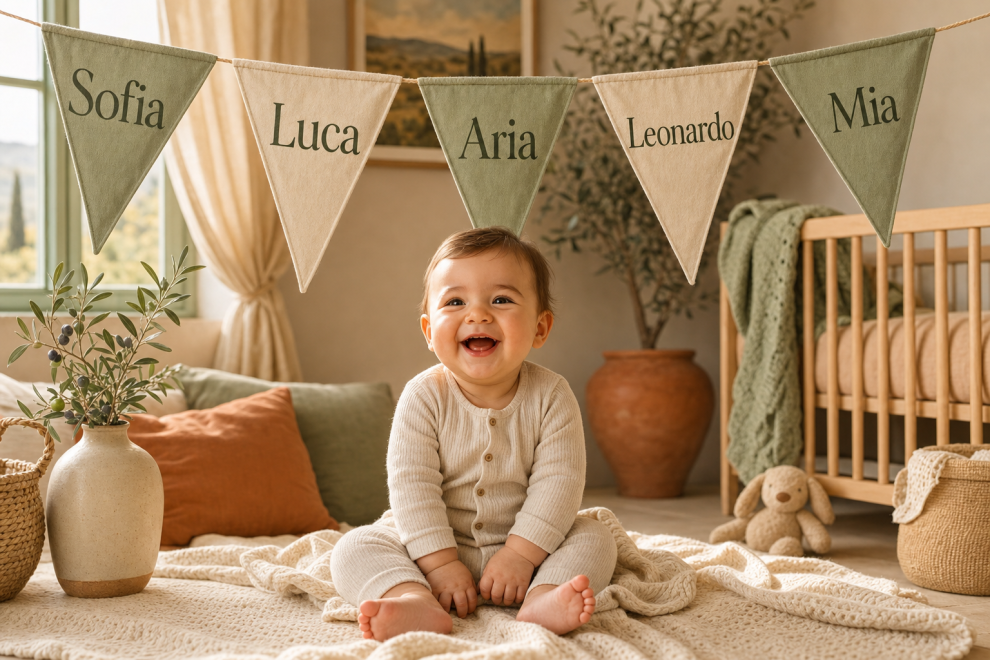
There’s a reason so many of us say an Italian name out loud and then just… say it again. Names like Leonardo, Gianna, and Luca seem to roll off the tongue the way warm afternoon light spills across a kitchen table. As a mom who has fallen down more baby-name rabbit holes than I’d care to admit, I keep circling back to the Italian ones — they sound like they already belong to someone, like there’s a whole sun-warmed story tucked inside before the baby has even arrived.

Italian baby names have a particular kind of pull. They feel rooted — in family, in faith, in centuries of art and music and Sunday tables — and yet they land on a modern American birth certificate and feel completely at home. That blend of heritage and ease is exactly why so many parents start a name search and end up lingering on the italian baby names. Part of it is the sound: all those open vowels and gentle endings that make even a small name feel like a little song. Part of it is the heritage. Many of these names have been carried for generations, through saints and painters and great-grandmothers, and they still feel fresh today.
The lovely thing about Italian names, compared with some other origins, is that they’re usually friendly to say. The spelling mostly matches the sound, the rhythm is forgiving, and grandparents tend to manage them on the first or second try. I’ve pulled together 32 of my favorite italian baby names below — girls first, then boys — each with its true meaning and a simple pronunciation guide, every meaning sourced from our name directory rather than from my own imagination. If you’re still casting a wide net, it’s worth browsing a broader sweep of baby names alongside these, and you can always see the full set on our Italian origin page. But if your heart is leaning toward Italy, you’re in beautiful company.
Italian Baby Girl Names
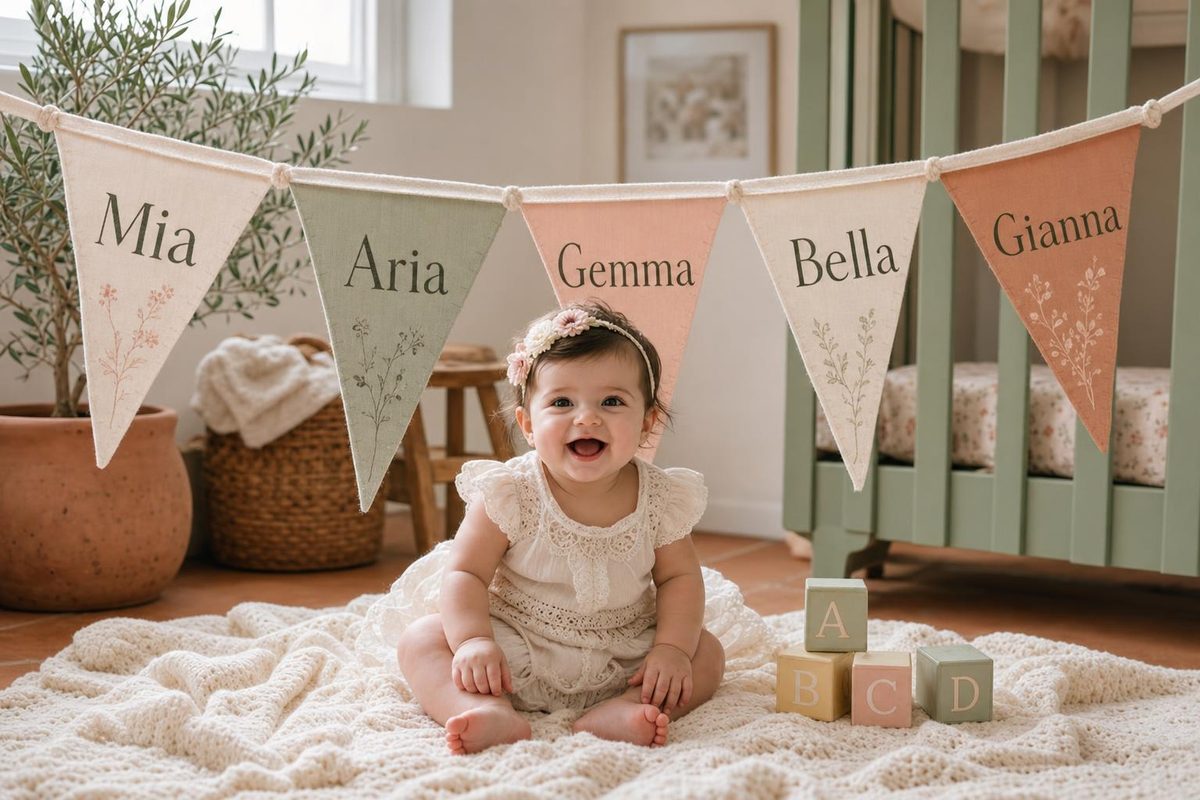
If you’re searching for italian baby girl names, you’ll notice a recurring melody of light, beauty, flowers, and faith. So many of the loveliest italian baby girl names braid softness and strength together, and almost all of them are a joy to say.
Mia (MEE-uh) — Meaning “mine,” “beloved,” or “my own.” Mia is one of those tiny, tender names that has quietly become a favorite all over the world. I love that its meaning is essentially a whispered you’re mine — about as sweet a thing as you can say over a crib.
Isabella (iz-uh-BEL-uh) — Meaning “devoted to God” or “pledged to God.” Isabella carries a regal, romantic weight, with a long line of queens behind it, yet it shortens easily to Bella or Izzy for everyday. It’s a name that grows up gracefully.
Aria (AHR-ee-uh) — Meaning “song,” “melody,” or “air” — an aria is the soaring solo in an opera. Aria is musical right down to its roots, which feels fitting for Italy, the home of opera. It’s modern and lyrical at the same time.
Gianna (jee-AH-nuh) — Meaning “God is gracious,” the Italian feminine form of John. Gianna gives such a familiar meaning a completely different music. It feels warm and a little spirited, and Gia makes a sweet nickname.
Liliana (lil-ee-AH-nuh) — Meaning “lily flower” and “pure.” Liliana is the kind of long, flowing name that sounds like it’s already wearing a Sunday dress. It nods to the lily, a flower long tied to purity and grace, and trims neatly to Lily or Lia.
Gabriella (gab-ree-EL-uh) — Meaning “God is my strength,” the Italian feminine form of Gabriel. Gabriella has a gentle power behind all that prettiness — what a meaning to hand a daughter. Bri and Ella are both waiting inside it.
Gemma (JEM-uh) — Meaning “gem” or “precious stone.” Gemma is short, bright, and exactly what it says: a little treasure. It comes straight from the Italian and Latin word for a jewel, and it has been carried by a beloved Italian saint.
Bella (BEL-uh) — Meaning “beautiful” or “lovely.” Bella is simplicity itself — it’s the Italian word for beautiful, used as a name. Whether you choose it on its own or as the heart of Isabella or Gabriella, it’s an easy, sunny pick.
Francesca (fran-CHES-kah) — Meaning “free” or “free person.” Francesca is the elegant Italian feminine of Francis, and I think it’s one of the most quietly sophisticated names on this list. Frankie or Frannie keeps it playful.
Bianca (bee-AHN-kah) — Meaning “white” or “fair.” Bianca is the Italian cousin of Blanche, with a crisp, clear sound that has shown up everywhere from Shakespeare to modern playgrounds. It feels both classic and a little bold.
Beatrice (BEE-uh-tris) — Meaning “she who brings happiness” or “blessed.” Beatrice carries real literary romance — she was the guiding figure in Dante’s great poem — and the meaning is hard to top. Bea or Bee makes the loveliest soft nickname.
Rosa (ROH-zuh) — Meaning “rose,” the flower. Rosa is tender, vintage, and quietly strong all at once — a single perfect bloom of a name. It carries beautifully across generations and pairs well with almost any middle name.
Luciana (loo-see-AH-nah) — Meaning “light” and “radiant.” Luciana takes the bright root behind Lucia and lets it stretch out into something flowing and luminous. Lucy or Lucia sits comfortably inside it for everyday.
Carolina (kair-oh-LY-nah) — Meaning “free woman” or “strong,” the graceful feminine line behind Charles. Carolina has a warm, old-world melody, and it gives you the friendly nicknames Carol, Lina, or Caro without losing its romance.
For more inspiration beyond this list, it can help to look through a broader collection of baby girl names and notice which sounds keep pulling at you.
Italian Baby Boy Names
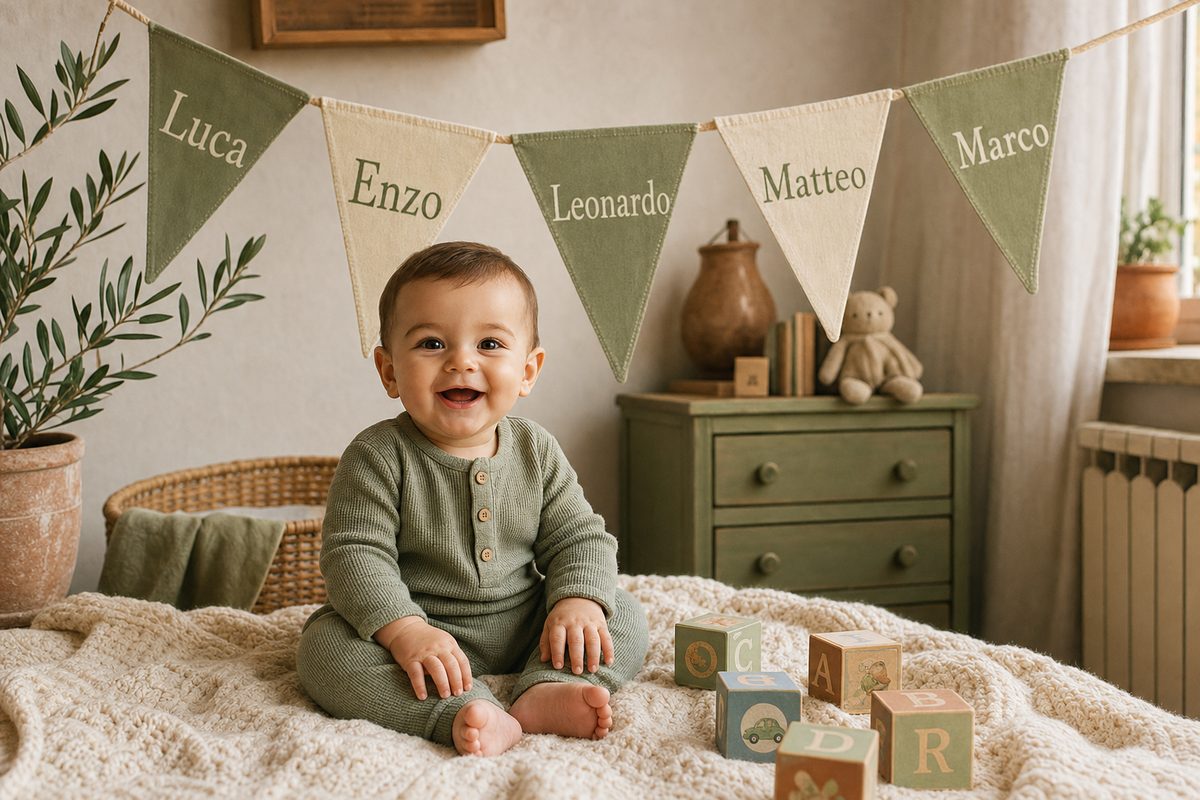
Italian baby boy names lean into a wonderful mix of saints, artists, kings, and a little Roman swagger. Some of the strongest italian baby boy names on this whole list sit right here, tied to figures who genuinely shaped Italian history, faith, and art.
Luca (LOO-kuh) — Meaning “light” and tied to the old region of Lucania; the Italian form of Luke. Luca is gentle, easy, and instantly recognizable as Italian without being hard to say. It’s been climbing fast with American parents, and I completely understand why.
Enzo (EN-zoh) — Meaning “ruler of the home.” Enzo has a zippy, confident sound — short, a little vintage, a little cool. It traces back through the Italian line of Henry, and that homey meaning gives it real warmth underneath the style.
Leonardo (lee-oh-NAR-doh) — Meaning “brave as a lion” or “lion-bold.” Leonardo carries the most famous Renaissance mind of all behind it, yet it still feels approachable, and it shortens to Leo, Leon, or Nardo. There’s a lot of life inside this one.
Lorenzo (loh-REN-zoh) — Meaning rooted in the ancient Italian town of Laurentum and the laurel tree, a long-standing symbol of honor and victory. Lorenzo sounds like a name that has seen some history — and it has, from Medici princes onward. Enzo or Renzo hides neatly inside it.
Giovanni (jee-oh-VAH-nee) — Meaning “God is gracious,” the Italian form of John. Giovanni is rich and musical, a name that fills the mouth in the best way. If you have a John, a Sean, or an Ivan in the family, this is a gorgeous way to honor him in Italian.
Matteo (mah-TAY-oh) — Meaning “gift of God,” the Italian form of Matthew. Matteo has soared in popularity here, and it’s easy to see the appeal: a warm meaning, a soft landing, and Matt or Teo ready whenever you need something shorter.
Antonio (an-TOH-nee-oh) — Traditionally glossed as “priceless” or “of inestimable worth.” Antonio is a true classic, carried by one of the most beloved saints in Italy. I’ll be honest about one thing: the deeper Roman root, Antonius, is of uncertain origin, so “priceless” is the cherished traditional meaning rather than a settled fact — a lovely sentiment to lean into all the same.
Nico (NEE-koh) — Meaning “victory of the people,” a short form of Nicholas. Nico is breezy and modern, the kind of name that works equally well on a toddler and a grown man. It carries the strong old meaning of Nicholas in a lighter, sunbuttoned package.
Dante (DAN-tay) — Meaning “enduring” or “steadfast.” Dante will always carry a whisper of the great Italian poet, which gives it a thoughtful, literary depth. The meaning — steadfast — is a quietly wonderful thing to wish for a son.
Alessandro (ah-les-SAN-droh) — Meaning “defender of men,” the Italian form of Alexander. Alessandro is grand and rolling, one of history’s great names dressed in its most musical Italian clothes. Alex or Sandro brings it back down to everyday size.
Angelo (AN-juh-loh) — Meaning “angel” or “messenger of God.” Angelo is tender and a little old-fashioned in the best way — a name that has been passed lovingly down Italian-American families for generations. The meaning needs no explaining.
Romeo (ROH-mee-oh) — Meaning “pilgrim to Rome,” one who has made the journey to the eternal city. Romeo is romantic and a touch daring, and yes, it carries Shakespeare with it — but the original meaning, a pilgrim walking toward Rome, is quietly beautiful on its own.
Marco (MAR-koh) — Meaning “of Mars” or “warlike,” the Italian form of Mark. Marco is clean, strong, and effortless to say. It carries a faint echo of Marco Polo and all that open-road adventure, while staying perfectly at home on a modern kid.
Valentino (val-en-TEE-noh) — Meaning “strong,” “vigorous,” and “healthy.” Valentino is unabashedly romantic — it shares its root with Valentine, the patron saint of love. It’s a big, glamorous name with Val tucked inside for the everyday.
Santino (san-TEE-noh) — Meaning “little saint” or “little holy one.” Santino is a warm, devotional Italian diminutive of Santo, and there’s something irresistible about a tiny baby carrying a name that means little saint. Sonny or Tino makes a sweet nickname.
Emilio (eh-MEE-lee-oh) — Meaning “rival” or “eager to excel.” Emilio has a sunny, melodic sound and a meaning with a little ambition baked in — eager to excel is a fine thing to wish for a child. It pairs as nicely with siblings as it stands alone.
Aurelio (ow-REL-ee-oh) — Meaning “golden.” Aurelio comes from the Latin for gold, and it carries the dignified shadow of the philosopher-emperor Marcus Aurelius. It’s uncommon here, which makes it a quietly distinctive pick with a luminous meaning.
If a name here catches your eye, browsing a wider set of baby boy names alongside it can help you test how it feels next to your favorites.
How to Say Italian Baby Names with Confidence
The good news about italian baby names is that the spelling and the sound usually agree — far more than English ever manages. For deeper reference, Behind the Name keeps audio clips for many of the names on this list. Here are the few patterns that helped me most.
- Every vowel gets its say. Italian vowels are clear and steady: a as in “father,” e as in “bet,” i as in “machine,” o as in “or,” u as in “boot.” That’s why Matteo is “mah-TAY-oh” — three little vowels, each pronounced.
- “c” before e or i softens to “ch.” That’s how Francesca becomes “fran-CHES-kah” and Luciana keeps its gentle middle. Before a, o, or u, the “c” stays hard, as in Carolina.
- “gi” and “gia” make a soft “j” sound. It’s why Gianna is “jee-AH-nuh” and Giovanni opens with that warm “jee.” Once you spot it, those names stop looking tricky.
- “ch” is a hard “k.” The opposite of English. So a name like Chiara would be “kee-AH-rah,” not “chee.”
- Double letters are leaned on, not skipped. The double “t” in Matteo and the double “s” in Alessandro get a tiny extra weight — a small thing that makes the name sound truly Italian.
My honest advice: when in doubt, listen. Hearing a name spoken once or twice does more than any written guide, including mine. It’s the quickest way to fall for the italian baby names that look longest on paper.
Choosing an Italian Name: What to Consider
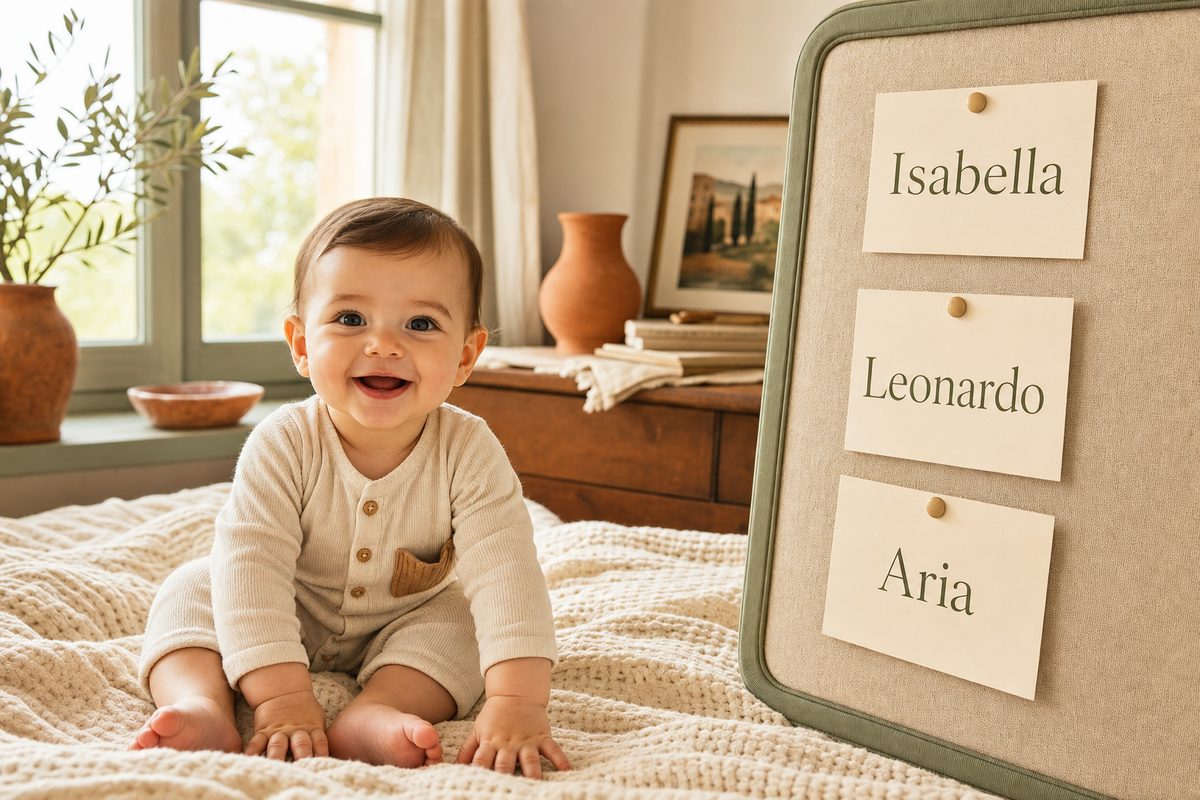
Picking any name is part heart, part practicality, and italian baby names add a couple of gentle things worth weighing. A few questions I’d sit with:
How does it flow with your last name and a middle name? Some Italian first names sing next to a more familiar middle name — think Leonardo James or Gianna Rose — which gives your child a built-in fallback if they ever want one. Say the whole name out loud a few times; your ear will tell you a lot.
Does the meaning resonate with you? One of the joys of Italian baby names is how rich the meanings run — brave as a lion, gift of God, she who brings happiness. If a particular meaning makes your chest feel a little warm, that’s worth paying attention to.
Is there a family or heritage connection? Many families choose an Italian name to honor their roots, and that thread of continuity can mean a great deal down the line. If you have Italian ancestry, this is a lovely way to carry a great-grandparent’s world forward.
Will it travel well? Most italian baby names are easy for English speakers, but a few of the longer ones — Alessandro, Liliana — are worth saying around the grandparents first. Almost all of them come with a friendly nickname tucked inside, which makes the longer choices feel approachable from day one.
Frequently Asked Questions
What are the most popular Italian baby names?
Names like Mia, Isabella, Luca, Gianna, Leonardo, and Matteo are among the most widely recognized and chosen italian baby names, and several of these italian baby names rank high on U.S. baby-name lists right now. These tend to be the Italian names American parents feel most confident saying out loud.
Are Italian baby names easy to pronounce?
Mostly, yes. Italian spelling and sound usually agree, so once you learn a couple of patterns — soft “c” before e or i, “gi” as a soft “j” — the italian baby names on this list become very friendly to read aloud, even the longer ones.
What's a good Italian name that works well in America?
Plenty travel beautifully. Luca, Mia, Leo (from Leonardo), Bella, Marco, and Gianna all feel completely at home on an American playground while still carrying their Italian roots and meanings, which is part of why they’ve become so popular here.
Do Italian baby names come with nicknames?
Almost always, and that’s part of their charm. Isabella gives you Bella, Alessandro gives you Alex or Sandro, Valentino gives you Val, and Leonardo gives you Leo — so a longer, more formal name still has an easy everyday version waiting inside it.
Where do the meanings of Italian names come from?
Many Italian names trace back to Latin, to the names of saints, or to older Greek and Germanic roots that settled into Italian over centuries. Each meaning on this list is drawn from our name directory, and where a meaning is genuinely uncertain, like Antonio, I’ve said so rather than guessing.
A Warm Send-Off
However you arrive at it, choosing your baby’s name is one of the first quiet conversations you’ll have about who this little person might be. Italian baby names give you so much to draw on, and the italian baby names on this list are only a starting point — light and lions, saints and gardens, art and faith, and generations of families who said these same warm sounds with love. Don’t let a long spelling scare you off a name your heart keeps returning to; a name is learned quickly and carried for a lifetime. Take your time, say your favorites out loud, and trust that you’ll know it when you hear it. Whatever you choose, your little one is going to wear it beautifully.
Related Articles

Elena Marsh
Elena Marsh is a writer, historian, and lover of names and where they come from. A mom of two, she went down the rabbit hole of name meanings and the cultures and stories behind them, and now writes warm, parent-to-parent guides to baby names from around the world. She researches and sources every meaning, and writes as a curious fellow parent rather than a credentialed linguist.

Add Comment