















 As the baby gets older, father remains the playmate of choice for both boys and girls, with his more physically active and challenging style. When two-and-one-half year old children want to play, more that two thirds of the time, they will choose their father over their mother.[7] Peter Blos, a psychologist, primarily known for his work with adolescents, looks to infancy studies to unlock clues to the father-son relationship and its consequences in the teenage years. He observes that the different ways that mother and father hold or play with their infant contributes to enriching and expanding the child’s budding individuation, the process where the child feels safe to become his own person.[8]
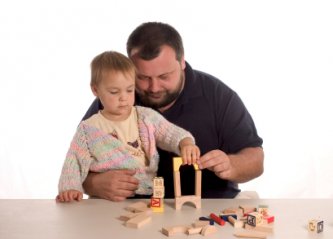 How does the empathic process work between father and child? They begin by paying attention to each other. For instance, father sets up a big pile of blocks, and the infant crawls over in a hurry to knock them over. The game is fun and includes learning and development, but in terms of the father-child relationship, the game is just a means for the baby and father to engage each other. When father restacks the blocks, he can see that his action spurs his child to get excited to knock them down again. And the baby gets more charged up at seeing his ability to affect his father. Researchers: Richard Koestner, Carol Franz & Joel Weinberger examine the different parental contributions at age 5 to the development of empathy in the adult as measured at age 31. Father’s involvement in childcare-spending time alone with his children performing routine childcare at least twice per week is the most important factor in developing empathy, the ability to feel as others do, while the second most important factor is mother tolerating the child’s dependent behavior.[12] Father does not have to be a paragon of virtue to contribute to the development of empathy in his child; he merely has to be available.
How does a father’s parenting style differ from a mother’s?
Table of Contents
Research highlighted in this article shows fathers tend to specialize in stimulating, physical play that arouses a child’s interest, while mothers lean toward caution and comfort. On the playground a father is often the one urging a child to try a little harder, while a mother is more likely to warn them to be careful. Children benefit from the combination of both.
Do babies respond differently to their fathers and mothers?
Yes. The article notes that by about eight weeks, infants already show different responses: as a mother approaches, a baby’s heart and breathing slow as it anticipates comfort, while as a father approaches, heart and breathing speed up in anticipation of livelier play. When babies are stressed, tired, sick, or in need of soothing, they still tend to reach for mother more often.
How does a father’s involvement affect a child’s development?
According to the research in this piece, involved fathers help build independence, problem-solving patience (dads tend to wait a bit longer before stepping in to help a frustrated child), and self-confidence. One factor strongly linked to a child’s later empathy was a father spending time alone doing routine childcare at least twice a week.
Does a father have to be perfect to make a positive difference?
No. As the article puts it, a father does not have to be a paragon of virtue to help his child develop empathy and security; he mainly has to be available and engaged. Simple, regular involvement is what counts most.






1 Comment