










By Sophia Richards
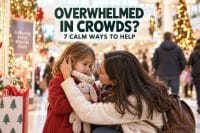
You’re halfway through the mall, or three aisles into a packed holiday store, or standing in a living room full of relatives who all want a hug — and your child has hit a wall. Maybe they’ve gone silent and clamped onto your leg. Maybe they’re covering their ears, or crying in a way that feels out of proportion to anything that’s actually happening, or trying to bolt for the door. When your child gets overwhelmed in crowds, it is easy to feel embarrassed, or to worry that you’ve somehow raised a child who “can’t handle” normal life. You haven’t. You have a child whose nervous system takes in the noise, the lights, the smells, and the sheer press of people more intensely than the next kid does — and who hasn’t yet learned how to turn the volume down on all of it.
As a mom of three and an early childhood educator, I’ve had the leg-clinger, the ear-coverer, and the one who was genuinely fine at a birthday party until minute forty, when she suddenly, completely, was not. For a long time I treated it like a behavior problem to be corrected, which only made both of us more miserable. What finally helped was understanding that this is largely about temperament — the innate emotional wiring a child is born with — and not about defiance or a lack of discipline. Some children simply have a lower threshold for stimulation and a slower, more cautious way of adjusting to busy, unfamiliar places. Once I saw it that way, I could stop fighting my kids and start helping them.
The short version of what helps: get ahead of the overwhelm instead of waiting for the meltdown, turn down whatever stimulation you can control, give your child a way out and a way to signal they need it, and stay calm enough yourself to be their anchor in the chaos. You don’t need all seven of the ideas below every single time. Pick the one or two that fit your child and the outing in front of you, and let them do their quiet work.
Why Your Child Gets Overwhelmed in Crowds
Table of Contents
Before we get to what to do, it helps to understand what’s actually happening, because it is almost never misbehavior. When your child gets overwhelmed in crowds, there is a real reason underneath it, even if your child is far too flooded in the moment to explain it.
The biggest piece is something the American Academy of Pediatrics describes as a child’s sensory threshold — part of the inborn temperament every child is born with. In its guide to understanding your child’s temperament, the AAP explains that some children have a low sensitivity threshold: they are highly aware of changes in their surroundings and may overreact to ordinary stimulation — light, noise, smells, textures, even the emotional temperature of a room. A crowded mall is a firehose of exactly those things. For a child with a sensitive threshold, it isn’t background hum they can tune out; it’s all turned up to ten at once, with no off switch.
Layered on top of that are two more temperament traits the AAP names. Some children are naturally slow to warm up or withdraw from new situations — hesitant and cautious, needing time before they feel safe in an unfamiliar, bustling place. And some are slow to adapt, finding changes and transitions genuinely hard and taking a long while to adjust. Put a sensitive threshold together with slow adaptability and a brand-new, loud, wall-to-wall-people environment, and the result isn’t a spoiled child. It’s a child whose wiring is doing exactly what it does, faster than they can manage.
There’s one more thing worth naming, because it changes how you’ll respond: the AAP is clear that temperament is, to a large degree, an innate pattern that is beyond a child’s control. Realizing that, they point out, makes it easier for parents to be patient and to lower the stress and strain the child is feeling. So the meltdown by the mall fountain is not your child choosing to ruin the trip. In our parenting guides I keep coming back to the same question, and it fits here perfectly: what’s the next kind, workable move? Not forcing a sensitive kid to “get used to it” by sheer exposure. The next small step that helps your child actually get through this outing — and trust that you’ve got them.
Seven Calm Ways to Help When Your Child Gets Overwhelmed in Crowds
1. Prep them before you go
The single most effective thing I ever did was stop springing crowded places on my kids. The AAP’s advice for children who are slow to adapt or quick to withdraw is to talk about change beforehand and prepare the child for change in advance — and a busy store or a big gathering is a huge change from the quiet of home.
So before we leave, I give a simple, honest preview: “We’re going to the mall. It’s going to be loud and there will be a lot of people. We’ll be there about an hour, we’ll get the two things on our list, and then we’ll come home.” For little ones, I keep it concrete — where we’re going, roughly how long, what we’ll do, and the fact that it might feel busy. Knowing what’s coming shrinks the shock. A child who has been told “this will be loud, and that’s okay, and here’s the plan” walks in braced and partnered-up instead of ambushed.
It also helps to give the crowd a name and a plan at the same time: “If it gets to be too much, squeeze my hand and we’ll find a quiet spot.” You’re not predicting failure. You’re handing a sensitive kid a map and an exit before they ever need one, which is exactly what lets them relax enough to maybe not need it at all.
2. Turn down the dials you can actually control
You can’t quiet a whole mall. But the AAP’s single clearest tip for a child with a low sensitivity threshold is to reduce stimulation levels wherever you can — and you have more control than it feels like in the moment.
Start with timing. A crowded store at 10 a.m. on a Tuesday is a different planet from the same store at 4 p.m. on a Saturday in December. If an outing is optional, aim for the quieter window. Keep trips short and single-purpose rather than stacking five errands into one long, fraying marathon; an overwhelmed child has a tank, and once it’s empty, nothing good happens no matter how much is left on your list. Bring the tools that take the edge off the input itself — noise-reducing headphones or earmuffs for a noise-sensitive kid are not coddling, they’re the equivalent of sunglasses on a bright day. A familiar comfort object, a snack before you go in so hunger isn’t stacked on top of everything else, a stroller or carrier so a tired toddler has a contained home base: each one is a dial you turned down on purpose.
None of this is lowering the bar on your child. When your child gets overwhelmed in crowds, it’s not stubbornness you’re managing — it’s a full sensory tank, so it’s engineering the outing so their nervous system has a fighting chance. If screens and constant input are part of what’s keeping your child’s baseline cranked high, our look at how much screen time is right for kids is a gentle nudge toward protecting the quiet, un-stimulating downtime that helps a sensitive child reset between busy days.
3. Build in a quiet exit and real breaks
Even with everything turned down, a sensitive child in a crowd is running their battery hot, and the AAP specifically recommends giving breaks to kids who get easily overloaded. So don’t wait for empty. Plan the escape hatch before you need it.
Scout the calm corners on your way in: a quiet bench near a window, the car in the parking lot, a family restroom, the far end of a less-busy aisle, the hallway outside the party room. Then use them early — a two-minute step-away when you see the first signs of fraying is worth ten times a thirty-minute recovery after a full meltdown. “Let’s go find some quiet for a minute” is a complete and dignified plan, not a punishment and not a failure.

And give yourself permission to leave for real. Sometimes the kindest, smartest move is to abandon the cart, skip the rest of the party, and go home while everyone can still walk out on their own feet. Leaving early isn’t giving in to your child; it’s reading the tank honestly. A child who learns “my grown-up will get me out before I shatter” becomes, over time, a child who can stay a little longer, because they trust the exit is always there.
4. Be their calm anchor
Here’s the one that’s hardest and matters most. The AAP makes the point plainly: children learn from what we do as much as from what we say, and parents model behavior in difficult or unexpected situations whether they mean to or not. When the store is chaos and your child is unraveling, they are reading your face and your body for the answer to one question: is this okay, or should I panic too?
So the work, as much as it’s possible, is to be the steady one. Lower your voice instead of raising it. Slow down your movements. Get down to their level, make calm eye contact, and let your own breathing be slow and even — kids borrow our nervous systems before they can run their own. A warm, quiet “I’ve got you, we’re okay, let’s take a breath together” does more than any instruction shouted over the noise. This is genuinely hard when you’re embarrassed and your own stress is climbing, and nobody does it perfectly. But even a mostly-calm grown-up gives a flooded child something solid to grab onto.
It helps to drop the audience out of your head, too. The strangers watching will forget your child’s meltdown in five minutes; your child will remember whether you were on their side. A child who gets overwhelmed in crowds needs, more than anything, to feel you stay steady. Being the anchor is a skill you can grow, and our guide to emotional regulation for kids has language and ideas for building that calm in both of you, well before the next crowded outing.
5. Give the big feeling a name and a small plan
A child who gets overwhelmed in crowds is, in AAP terms, often a child whose temperament runs to intensity — they feel things in extremes and may yell or cry rather than explain. The AAP’s guidance there is to practice tolerance and model more appropriate ways to respond, rather than to punish the big feeling. You can start that long before the crowd.
In a calm moment at home, give the feeling simple words: “Sometimes places get too loud and too busy, and your body feels like it’s too much. That feeling has a name — it’s called feeling overwhelmed, and lots of people feel it.” Then build one tiny, portable plan together. A signal they can use when words are gone — a hand squeeze, a specific word, a thumbs-down. One coping move they can actually do in the moment — a few slow “smell the cocoa, blow out the candle” breaths, pressing their palms together, or burying their face against your shoulder for a count of ten.
The goal isn’t to talk a flooded child out of their feelings on the spot; that rarely works for anyone. It’s to have handed them, in advance, a word for what’s happening and one small thing to do with it, so the experience is slightly less terrifying and a little more manageable each time. Over months, a child who once got overwhelmed in crowds at the first wave of noise learns to reach for their signal and their breath before the flood takes over.
6. Go at their pace, in short and repeated doses
It is so tempting to think the cure for crowd overwhelm is more crowds — throw them in the deep end until they toughen up. The AAP points the opposite way for slow-to-adapt and cautious kids: let the child go at their own pace and try multiple brief exposures rather than one overwhelming plunge.
In practice, that means building tolerance in small, winnable steps. A quick ten-minute trip to a moderately busy store, ended on a good note before the tank is empty, teaches your child’s body “we did a busy place and we were okay” far better than a two-hour holiday-mall epic that ends in tears. Let them set some of the pace — hang at the edge of the party before joining, watch the busy playground for a few minutes before stepping in, hold your hand as long as they need to. Each small, successful outing is a deposit in the “I can handle this” account.

And celebrate the small wins out loud and warmly: “You stayed in that busy store the whole time we needed — that was hard and you did it.” You’re not just getting through today’s errand. You’re slowly, patiently showing a sensitive child that busy places are survivable, which is how a kid who melts down at four grows into one who can navigate a crowded world at ten.
7. Respect their wiring, and skip the shame
This is the heart of all of it. Because temperament is largely innate and, as the AAP says, beyond a child’s control, the worst thing we can do is treat a sensitive child’s overwhelm as a character flaw to be scolded out of them. The AAP’s guidance for easily-overloaded kids is explicit: respect their preferences when possible, and redirect without anger or shame.
So resist the labels, even the ones said with a sigh — “she’s so dramatic,” “he can’t handle anything,” “don’t be a baby.” A child hears those, believes them, and adds shame to an already-overflowing cup. Resist forcing the hug from Grandma, the costumed character photo, the loud group activity when every signal says no; honoring a clear “I can’t right now” teaches a child that their limits are real and that you’ll help them hold the line. The AAP frames this as “goodness of fit” — when we understand a child’s temperament and adjust how we respond, we avoid a world of misunderstanding and conflict, and the child is freed up to grow.
And here’s the hopeful part the AAP names directly: the very intensity and sensitivity that makes crowds hard often matures into something wonderful — enthusiasm, determination, deep empathy, a child who notices everything and cares intensely. You are not trying to erase your child’s sensitivity. You’re helping them carry it. A lot of what fills a sensitive child’s cup back up is unhurried, low-stimulation, open-ended time to just be a kid, which is one more reason our piece on the importance of play belongs in the same conversation as surviving the busy season.
When to Talk to Your Pediatrician
For most children, getting overwhelmed in crowds is a normal expression of a sensitive, cautious, or intense temperament, and it eases as they grow more mature and more practiced — especially with the gentle, prepared approach above. The steps here handle the large majority of crowd meltdowns. But sometimes a conversation with your child’s doctor is worth having, and asking is never an overreaction.
The AAP notes that your pediatrician can help you distinguish a challenging temperament from other things going on — recurrent or chronic illness, or emotional and physical stress, can cause behavioral difficulties that aren’t really about temperament at all. So it’s reasonable to check in if your child’s overwhelm seems to be getting worse rather than better over time, or if it arrives alongside other changes like sleep trouble, new fears, or regression.
It’s also worth mentioning to your pediatrician if sensitivity to noise, lights, textures, or crowds is intense and pervasive — showing up strongly across many settings, not just the occasional busy outing — or if it’s genuinely interfering with everyday life, school, friendships, or your family’s ability to do ordinary things. None of this means your child has a problem, and this article isn’t a diagnosis of anything; covering their ears in a loud store is not, by itself, a sign of any disorder. It simply means your pediatrician can take a wider look, reassure you when things are right on track, and point you toward support if it’s helpful. Trusting that instinct to ask is good parenting, not overreacting.
A Crowd-Day Plan Small Enough to Use
If seven ideas feel like a lot while you’re wrestling a coat onto a reluctant toddler, shrink them to a card you could keep in your bag: tell them what’s coming before you go, turn down whatever stimulation you can, scout a quiet exit and use breaks early, be the calm they borrow, give the feeling a name and one small coping move, go in short and repeated doses at their pace, and respect their wiring instead of shaming it. That’s the whole plan.
With three kids of my own, I can tell you this gets better, slowly and then noticeably. In my house, the turning point wasn’t toughening anyone up. It was the day I stopped dragging my most sensitive one through a packed store on the edge of a meltdown, parked the cart, and took her out to the car for three quiet minutes to just breathe with me — and then we went back in and finished, calmly, together. The crowds didn’t get smaller. But she learned that busy places came with an exit and a grown-up who understood, and a couple of years later I watched that same kid walk into a loud birthday party, pause at the doorway to take it in, and then join the fun on her own steam. When your child gets overwhelmed in crowds, you are not raising a child who can’t cope. You are raising a sensitive, perceptive one who is learning — with your steady help — how to meet a loud world on their own terms.
Frequently Asked Questions
Why does my child get so overwhelmed in crowds when other kids seem fine?
Because children are born with different temperaments, and one of the inborn traits the American Academy of Pediatrics describes is sensory threshold — how much stimulation a child can take before it’s too much. A child with a low threshold is highly aware of noise, lights, smells, and commotion and can be flooded by a busy place that barely registers for another kid. It’s not that your child is weaker or more dramatic; their nervous system genuinely takes in more, faster. Understanding it as wiring rather than misbehavior is the first step to helping them.
Should I avoid crowded places to protect my sensitive child, or will that make it worse?
You don’t have to choose between the deep end and total avoidance. The AAP’s guidance for cautious, slow-to-adapt kids is to let them go at their own pace and try multiple brief exposures, which means short, manageable trips rather than either forcing long overwhelming outings or skipping busy places entirely. Protect them from being flooded, but keep offering small, winnable doses — a quick errand ended on a good note, a few minutes at the edge of a party. That steady, gentle practice builds real tolerance over time without the trauma of being overwhelmed.
How do I calm my child down once they're already melting down in a store?
In the moment, reduce the input and be their anchor. Get them to the quietest spot you can reach quickly — a bench, a family restroom, the car — and lower your own voice and pace rather than matching their panic, since children borrow our calm before they can make their own. Skip the lecture; a flooded child can’t process instructions. A quiet “I’ve got you, let’s breathe together” and a few slow breaths does more than anything you could explain. Once they’ve come down, you can leave or ease back in, but regulation comes before reasoning every time.
Is getting overwhelmed in crowds a sign that my child has a sensory disorder or autism?
Not by itself. Plenty of children with no diagnosis at all are simply sensitive or slow to warm up by temperament, and crowd overwhelm is a very common, normal part of that. This article isn’t a diagnosis of anything. That said, the AAP notes your pediatrician can help distinguish temperament from other things going on, so if the sensitivity is intense and pervasive across many settings, seems to be worsening, or is genuinely interfering with daily life, school, or friendships, it’s completely reasonable to mention it to your child’s doctor. Often they’ll reassure you it’s age-appropriate; sometimes they’ll help you look a little closer. Asking is never an overreaction.
How can I prepare my child before a big holiday gathering or busy event?
Talk about it in advance, which is exactly what the AAP recommends for kids who adapt slowly or withdraw from new situations. Give a simple, honest preview: where you’re going, that it will be loud and crowded, roughly how long you’ll stay, and what the plan is if it gets to be too much. Agree on a signal they can use when they’re overwhelmed and a quiet spot they can retreat to. Bring comfort tools like headphones or a familiar object, feed them beforehand, and build in breaks. Walking in with a map and an exit already in hand helps a sensitive child feel partnered-up instead of ambushed.
Related Articles

Meet Sophia Richards Sophia Richards is an early childhood educator, passionate writer, and the proud mom of three energetic kids. With a degree in Education and over a decade of hands-on classroom experience, Sophia bridges the gap between professional teaching strategies and everyday family life. At More4Kids, she translates complex child development concepts into practical, actionable parenting tips that families can use at home.
Whether she is sharing positive reinforcement techniques, educational crafts, or honest reflections on the chaos of raising three children under one roof, Sophia’s goal is to empower parents to foster resilience and joy in their kids. When she isn't writing or lesson planning, you can find her organizing neighborhood scavenger hunts or trying out new kid-friendly recipes.
Areas of Expertise: Early Childhood Education, Positive Parenting, Sibling Dynamics, Educational Play, Family Wellness.

Add Comment