












By Sophia Richards
The lights go off, the door clicks almost-closed, and you make it three steps down the hall before you hear it: “Mommy? I’m scared.” Maybe it’s the shadow the curtain makes, or the closet that looked perfectly ordinary an hour ago, or a monster with no name that only comes out when the room goes dark. If bedtime at your house has turned into a nightly standoff because your child is afraid of the dark, take a breath — you are not raising a “difficult” kid, and you have not done anything wrong. You are parenting a child with a big, healthy imagination, right on schedule.
I have three kids and years as an early-childhood educator, and I have sat on the edge of a lot of beds in the dark, holding a small hand while a small voice explained exactly what was hiding behind the dresser. So let me start with the reassuring part: a fear of the dark is one of the most ordinary parts of early childhood there is. It is not a sign of weakness, spoiling, or too much screen time. It is a stage — and like most stages, there is a calm, gentle way through it that helps your child feel brave instead of ashamed. Let me walk you through why it happens and what actually works.
Why Is My Child Suddenly Afraid of the Dark?
Table of Contents
Before we fix anything, it helps to understand what is really going on, because once you see the fear through your child’s eyes it stops looking like drama and starts looking like development.
A big part of it is that wonderful, runaway imagination. As the pediatrician Dr. Laura O’Connor of Cleveland Clinic explains, “It’s relatively common for young children at some point to have irrational fears,” and how the grown-ups around them respond to those fears shapes their ability to fall asleep and stay asleep. Somewhere around ages two to three, most children develop enough imagination to invent wonderful stories — and the very same brain that dreams up a friendly dragon at lunchtime can conjure a far less friendly one at 8 p.m. In the dark, without the familiar shapes of the room to anchor them, that imagination fills the empty space with whatever it can find. Your child is not being manipulative. In their world, the fear is completely real.
There is a practical stakes piece here too. A fear of the dark is not just a rough half-hour at bedtime; left unaddressed, it can genuinely rob your child of the sleep they need, and short-changed sleep spills over into mood, behavior, and health the next day. That is why it is worth taking your child’s nighttime fears seriously and helping them through — not because the monster is real, but because the tiredness that comes from fighting it every night absolutely is.
Knowing all of that reframes the whole project. You are not fighting your child, and you are not fighting the monster either. You are coaching a very young person through one of their first big, scary feelings, at a pace they can handle. A child afraid of the dark is not asking you to be braver for them; they are asking you to stay calm and steady while they slowly learn to be braver for themselves.
Is Being Afraid of the Dark Normal?
In a word: yes. If you take away one thing today, let it be this — a child afraid of the dark is a child whose development is going exactly the way it should. Fears come and go across childhood in fairly predictable waves: separation in the toddler years, the dark and imaginary creatures in the preschool years, more realistic worries like burglars or storms as kids get older. Your child is not broken, and neither is your bedtime.
What matters is not whether the fear shows up, but how it is met. A fear that is heard, taken seriously, and gently walked through tends to shrink over weeks and months. A fear that is either dismissed (“there’s nothing there, go to sleep”) or over-fed (“let me check the closet for monsters again”) tends to dig in. The good news is that the same handful of calm, consistent moves work for most children — and none of them require you to leave your child to sob alone in the dark.
One quick note on where this fits. If your struggle is less “I’m scared” and more “I just don’t want to sleep in my own bed,” that is a slightly different puzzle — worth reading alongside our guide to gentle bedtime rituals, which pairs beautifully with everything below. This article is about the fear itself.
What Helps a Child Afraid of the Dark Feel Safe at Night
Here is the calm, doable plan. Think of these less as a checklist to race through and more as a set of gentle habits you layer in over a week or two. Dr. O’Connor offers a set of practical moves, and I have folded in what has worked in my own house alongside them.
1. Get to the root of the fear
Start by finding out what, exactly, is scary. Ask open-ended questions and really listen, so your child can name the fear instead of just feeling swallowed by it. “When a child is scared, they can benefit from sharing it with someone,” Dr. O’Connor says. “Feeling heard can help them lift the weight of that fear.” What sounds trivial to you — a coat on a hook, a fan’s hum — can feel enormous to them. Knowing the specific fear lets you offer comfort that actually fits it, instead of a general “you’re fine.”
2. Don’t accidentally feed the fear
This one surprises a lot of loving parents. It is tempting to march in with a flashlight, “check” under the bed, and announce the room is monster-free. But Dr. O’Connor cautions that hunting for the creature or promising to banish it can quietly backfire: if you act like the scary thing might be real, your child hears confirmation that there really is something to worry about. Instead, acknowledge the feeling without buying into the story. Something like: “I know you feel scared, and I understand the dark can feel that way. But that shadow is just your coat on the door, and nothing in here can hurt you.” You are validating the emotion while staying calmly certain about the facts.

3. Keep comfort in their own room
When the fear spikes, it is far better to go to your child than to let your child come to you. Bringing them into your bed, Dr. O’Connor notes, tends to delay real sleep and does not help them learn to settle where they actually sleep. If they need you, step into their room, reassure them that their bed is a safe place, and then head back out. If they wake in the night, keep it short and boring: a calm “everything’s okay, your room is safe, I love you,” and out again. She adds that it is generally best not to stay and camp out in the room unless your child is extremely frightened, because lingering can send the message that there really is a reason to be on guard.
4. Build your child up during the daytime
A lot of nighttime bravery is actually built in the daylight. During the day, when nothing is scary, talk with your child about their bedtime fears and quietly work on confidence and coping skills. You might rehearse a brave thought together, practice a “boss the fear back” phrase, or simply notice out loud all the ways they are capable and strong. Handling the fear when the sun is up — when it is small and manageable — gives your child a running start on handling it after dark.
5. Guard the wind-down and keep the routine light
A predictable, happy, low-key bedtime routine is the runway that lands the plane. Keep the last stretch of the day calm and pleasant, and be a fierce gatekeeper about what goes in right before bed. In the 30 to 60 minutes before lights-out, steer clear of scary movies, tense shows, spooky stories, unsettling music, or anything that revs a young imagination in the wrong direction. Trade it for a warm bath, a couple of gentle books, and quiet, cozy time. What your child’s mind chews on at 7:30 is often exactly what it serves back up at 8:00.
6. Use nightlights and comfort objects
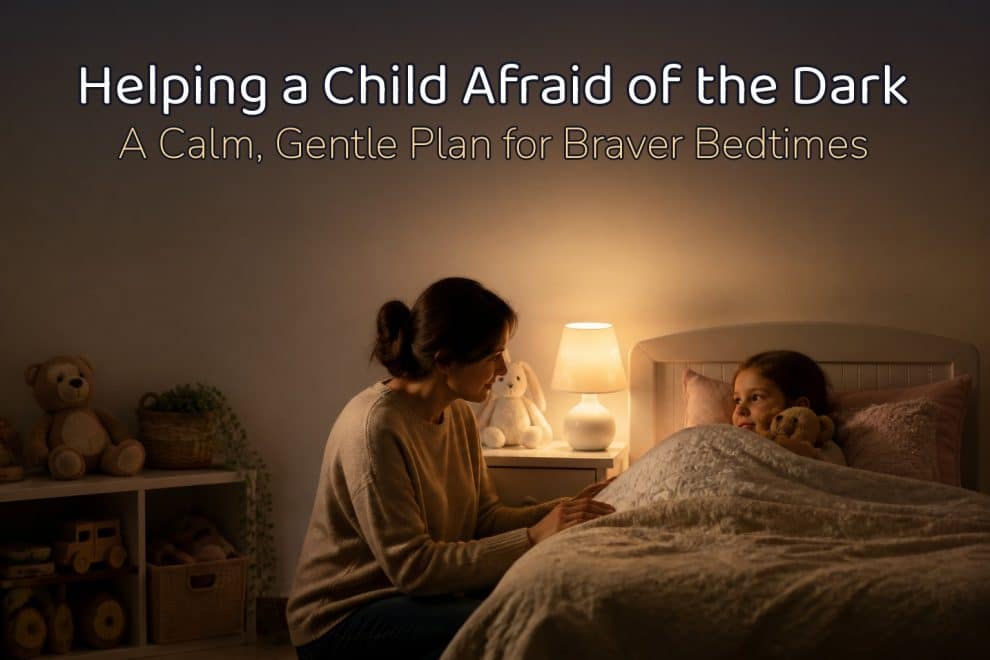
You do not have to make the room pitch black to help your child “beat” the dark — a little light is a completely reasonable tool. Many children who are afraid of the dark feel safer with a nightlight or a very dim lamp, and a special stuffed animal or blanket in bed gives them something warm and familiar to hold onto. Leaving the bedroom door open or cracked can help too, as long as your child understands the open door is for comfort, not an invitation to wander the house after lights-out. The goal is not to eliminate every shadow; it is to give your child small, steady anchors that say safe.

7. Catch them being brave
Finally, notice and celebrate the wins. Positive reinforcement works wonders with younger kids, so lay the praise on thick after a good night: “You stayed in your own bed all night — I am so proud of how brave you were!” For toddlers and preschoolers, a small reward like a sticker chart can give a little extra motivation to face the dark. You are not bribing away a real fear; you are helping your child feel the pride of doing a hard thing, so that bravery starts to feel like who they are.
What Not to Do When Your Child Is Scared of the Dark
When you are exhausted and it is the fourth call down the hall, some very natural moves quietly make things harder. A few worth naming:
- Don’t dismiss the fear. “There’s nothing to be scared of, go to sleep” lands as “my big feeling doesn’t count.” A child who feels unheard tends to protest louder, not less.
- Don’t stage elaborate monster hunts. Checking the closet, spraying “monster spray,” or promising to guard the door all treat the imaginary threat as real. Comfort the child, not the monster.
- Don’t cave to the bed-swap every night. An occasional snuggle during a rough patch is human, but a nightly migration into your bed teaches your child they can only feel safe next to you — the opposite of what you are trying to build.
- Don’t add scary inputs. That “just one” spooky episode or creepy bedtime book can echo for hours. Keep the pre-sleep hour gentle.
- Don’t expect it gone in a night. Fears fade with steady, patient repetition. A hard night is not proof the plan failed; it is just part of the work.
When a Fear of the Dark Is More Than a Phase
For most kids, the calm plan above is enough, and the fear softens over a few weeks. But sometimes it runs deeper, and it helps to know where the line is.
Dr. O’Connor’s guidance is a good rule of thumb: if the fear of the dark drags on for an extended stretch, or comes bundled with other fears and excessive worries, it is worth checking in with your child’s healthcare provider. An intense, persistent fear of the dark even has a clinical name — nyctophobia. As Cleveland Clinic notes, a severe fear can genuinely disrupt sleep and leave a child exhausted during the day, and it is worth asking a provider about help if the fear brings on panic or your child starts avoiding anything to do with the dark. The reassuring part is that this is treatable: approaches like gradual exposure, cognitive behavioral therapy, and simple relaxation techniques can help a child learn to feel calm in the dark again. Reaching out is not overreacting — it is exactly the kind of attentive parenting that gets a struggling kid real relief.
And trust your gut. You know your child. If something about the intensity, the duration, or the toll it is taking feels off to you, that instinct is worth acting on. Naming a fear out loud to a professional does not make it bigger; it just gets your child more hands helping to carry it.
You will get through this. One calm, patient, gently-lit night at a time, your child will learn that the dark is just the room with the lights off — and that they are brave enough to be in it. For more steady help at bedtime, our parenting section and our guide for the nights you dread bedtime are here whenever you need a next step, and if you are working with a little one, our baby sleep schedule by age walks through the earlier stages too.
Frequently Asked Questions
At what age are kids most afraid of the dark?
A fear of the dark most often shows up in the preschool years, roughly ages two to five, when a child’s imagination becomes vivid enough to invent things that go bump in the night. It can appear earlier or linger into the early school years, and it frequently comes and goes in waves. For most children it is a passing developmental stage rather than a lasting problem, and it tends to ease with calm, consistent reassurance.
Should I let my child sleep with a nightlight?
Yes — a nightlight or a very dim lamp is a perfectly healthy tool for a child afraid of the dark, and it can help them feel safe enough to settle and stay asleep. A soft, warm light is best, and keeping it low rather than bright helps protect the sleepy, wind-down mood of the room. Pair it with a comfort object like a favorite stuffed animal or blanket for an extra anchor of security.
Is it bad to check for monsters to reassure my child?
Pediatric guidance actually advises against monster hunts. When you search the closet or promise to get rid of the creatures, you unintentionally signal that the scary thing might be real, which can reinforce the fear. A better move is to acknowledge your child’s feeling while staying calm and matter-of-fact that the room is safe and nothing there can hurt them — comforting the child rather than confirming the monster.
When should I worry about my child's fear of the dark?
Most fear of the dark is normal and fades with gentle, consistent support. It is worth talking to your child’s healthcare provider if the fear lasts for an extended period, is paired with other fears or excessive worry, brings on panic, or leads your child to avoid situations involving the dark. Persistent, intense fear can affect sleep and daytime functioning, and effective help — including exposure-based approaches and therapy — is available.
Related Articles

Meet Sophia Richards Sophia Richards is an early childhood educator, passionate writer, and the proud mom of three energetic kids. With a degree in Education and over a decade of hands-on classroom experience, Sophia bridges the gap between professional teaching strategies and everyday family life. At More4Kids, she translates complex child development concepts into practical, actionable parenting tips that families can use at home.
Whether she is sharing positive reinforcement techniques, educational crafts, or honest reflections on the chaos of raising three children under one roof, Sophia’s goal is to empower parents to foster resilience and joy in their kids. When she isn't writing or lesson planning, you can find her organizing neighborhood scavenger hunts or trying out new kid-friendly recipes.
Areas of Expertise: Early Childhood Education, Positive Parenting, Sibling Dynamics, Educational Play, Family Wellness.

Add Comment