















By Sophia Richards
Something is off, and you can see it in your child's body before they say a word.
They freeze at the door before school. They ask the same worried question three times. They pull back from a birthday party they were excited about yesterday. They cannot sleep because something unnamed is pressing on them.

Knowing how to help an anxious child can feel harder than it looks. You want to take the worry away. You want to say the right thing. Some days you get it right, and some days you see that your words landed sideways and you are not sure why.
As a mom of three, I have been in every one of those moments. As an early childhood educator, I have sat with a lot of children who carry worry quietly or loudly or sideways. The thing I keep coming back to: helping an anxious child usually starts smaller than parents expect.
What Child Anxiety Looks Like at Home
Table of Contents
Anxiety in children does not always look like nervousness. It can show up as:
- stomachaches before school with no physical cause
- meltdowns or anger right before transitions
- avoidance of activities they once enjoyed
- repeated "what if" questions at bedtime
- clinging to a parent or needing constant reassurance
- trouble falling asleep most nights
None of these signals alone tells you everything. But when several of them keep circling around specific situations, worry is often underneath.
Child anxiety is common. The Child Mind Institute's guide to anxiety in children notes that anxiety is one of the most frequently seen challenges for kids — and many children experience anxious feelings that do not rise to a clinical level but still benefit from steady, warm support at home.
How to Help an Anxious Child in the Moment
When worry has already arrived, there are a few things that actually help.
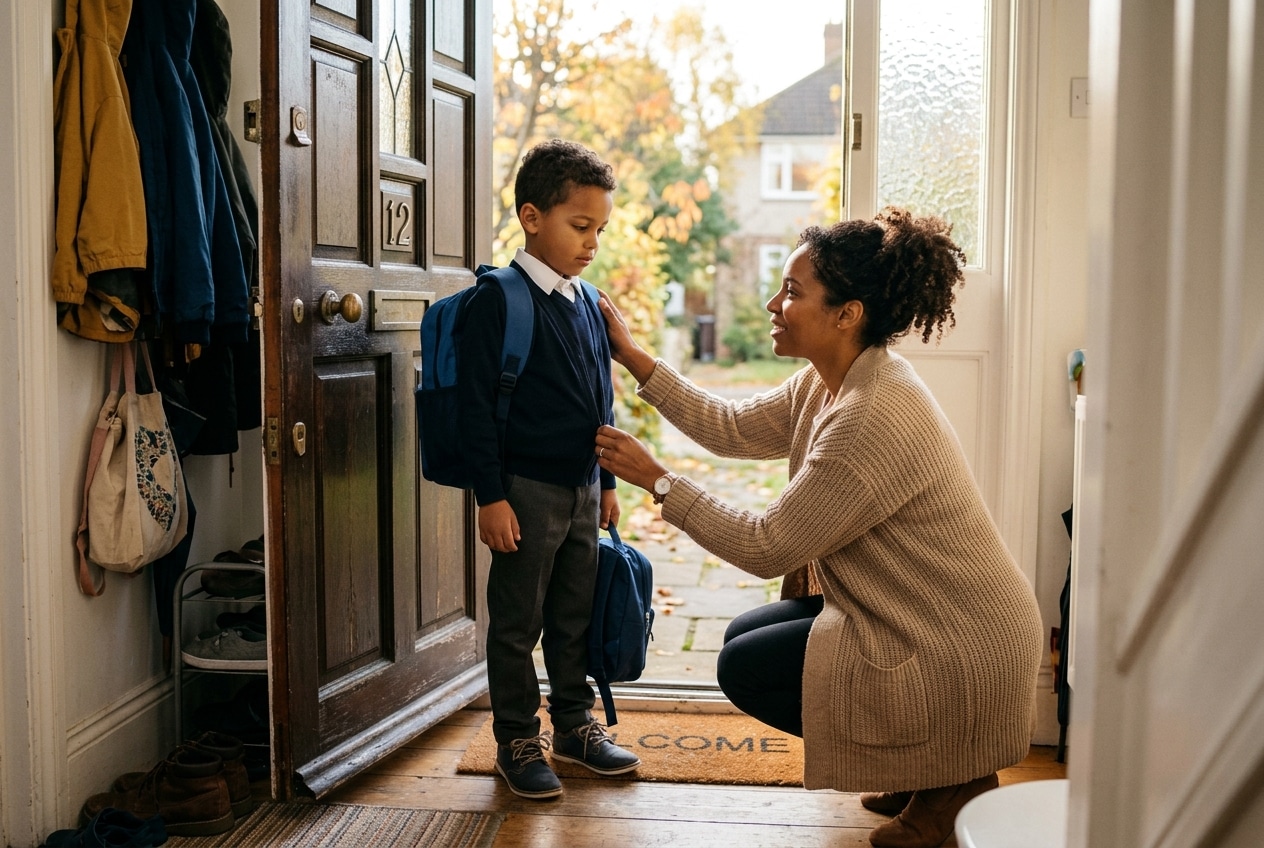
Get low
Meeting a child at eye level shifts the register of the moment. It communicates safety before any words arrive.
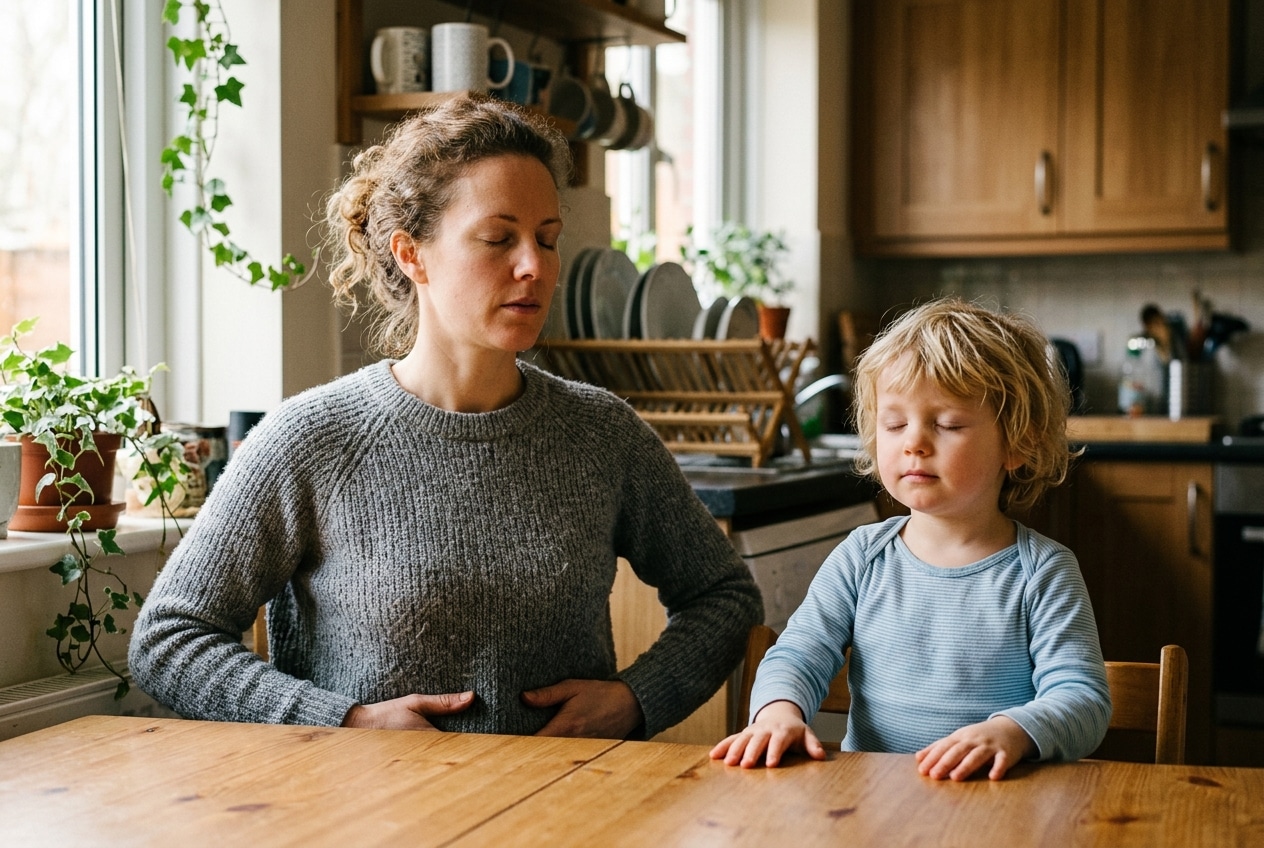
Slow your own breath first
Anxious children often read a parent's body before they hear their words. If you soften your shoulders and slow your exhale, that signal reaches your child faster than most reassurances.
Name the feeling without inflating it
"You seem like you have a worried feeling right now" is usually enough. You do not need to add "is something wrong?" or "why are you always like this?" The naming is often the beginning of the release.
Do not immediately solve
When a child says "what if the teacher is mean?" they are not always asking you to audit the situation. Sometimes they need you to acknowledge the worry before they can hear anything else. The NHS guidance on helping children with anxiety notes that listening actively and validating a child's feelings — without dismissing or amplifying them — is one of the most effective first steps a parent can take.
Simple breathing works
Belly breathing, box breathing, or a slow exhale to a count of five gives a child's nervous system something concrete to do. "Let's take a slow breath together" is usually better than a lecture on calming strategies. If you want a broader set of approaches, the guide to mindfulness techniques for kids has practical options that work at home without any special equipment.
What to Say — and What to Avoid
We get this wrong with good intentions. A few shifts that tend to help:
Instead of "There's nothing to be scared of" → try "That makes sense to feel worried about."
Instead of "Don't be anxious" → try "What's the smallest part of this we could try first?"
Instead of "You'll be fine" → try "I'll be here. Let's figure it out together."
The word "fine" tends to close a conversation. It signals that the worry is not that big a deal, which can make an anxious child feel unheard, or feel that they are wrong for having the feeling at all.
What helps instead is language that holds the worry *and* opens a door. You are not agreeing that the danger is real. You are agreeing that your child's experience of it is real.
The Mayo Clinic's guidance on anxiety in children underlines this point: that over-reassuring children can actually maintain worry over time, while warm presence combined with gentle encouragement to face manageable fears tends to help more.
How Routine Can Help an Anxious Child
Anxious children often do well with predictable rhythms. Not a rigid schedule, but a reliable pattern of what-comes-next.
When a child knows that school is followed by snack, snack is followed by outdoor time, and dinner is followed by a bath and story, the day has walls. Those walls are not limiting — they are calming. Predictability reduces the number of transitions that feel like unknowns.
A simple daily routine does not have to be elaborate. One anchor in the morning and one before bed is often enough to give a worried child the ground beneath their feet.
When routines shift — travel, a new school year, a big family change — it helps to announce the change early, keep some familiar pieces in place, and build in a little extra connection time. Not because the change is dangerous, but because transitions are genuinely harder for some children.

In my house, the bedtime anchor has been the most protective. On the nights we skip it, I can feel the difference by morning. It is not magic — it is just that predictability gives a child's nervous system room to settle.
Building Small Brave Experiences
One of the most useful things parents can do alongside helping an anxious child is support their confidence through small, repeated brave moments.
This is not about pushing or forcing. It is about choosing manageable challenges and staying close enough that your child is not alone with the hard part. Ordering their own food. Knocking on a neighbor's door. Trying a new activity for just one session before committing.
Each small success builds evidence that the worry was bigger than the actual outcome. Over time, that evidence accumulates.
The guide to raising a resilient child covers this in more depth — that resilience is not something a child either has or does not have, but something that grows through experience and steady parental support. The same is true for anxious kids: every small brave step adds up.
As an early childhood educator, I sometimes watched children who seemed very worried at drop-off become completely different kids by mid-morning once they had successfully navigated one small thing — chose a book from the basket, helped set out materials, said hello back. The classroom taught me that small competence moments matter more than big pep talks.
When to Ask for More Support
Most children go through worried phases that ease with consistent support at home.
If anxiety is:
- making it hard for your child to complete normal daily activities most days
- interfering with school or friendships over several weeks
- causing physical symptoms like stomachaches or headaches regularly
…it is worth talking with your child's pediatrician. A referral to a therapist who works with children can make an enormous difference. Asking for help is a sign of attentive parenting, not a failure.
You Are Already Doing Something
If you are reading this, you are paying attention. That matters.
Children with an anxious temperament do not need perfect parents. They need parents who stay curious about what is going on underneath, who do not shame them for their worry, and who hold the door open even when the child is not quite ready to walk through.
How to help an anxious child is not a formula. It is a practice of noticing, staying present, and trusting that small, consistent responses add up over time.
Some days will go better than others. That is true for every family. You are building something real, one gentle moment at a time.
Related Articles
- 7 Mindfulness Techniques For Kids To Reducing Stress And Anxiety
- A Secret To Happy Kids Daily Routines
- Raising Resilient Children

Meet Sophia Richards Sophia Richards is an early childhood educator, passionate writer, and the proud mom of three energetic kids. With a degree in Education and over a decade of hands-on classroom experience, Sophia bridges the gap between professional teaching strategies and everyday family life. At More4Kids, she translates complex child development concepts into practical, actionable parenting tips that families can use at home.
Whether she is sharing positive reinforcement techniques, educational crafts, or honest reflections on the chaos of raising three children under one roof, Sophia’s goal is to empower parents to foster resilience and joy in their kids. When she isn't writing or lesson planning, you can find her organizing neighborhood scavenger hunts or trying out new kid-friendly recipes.
Areas of Expertise: Early Childhood Education, Positive Parenting, Sibling Dynamics, Educational Play, Family Wellness.

Add Comment